
As more crypto activity moves on-chain, wallets are becoming much more than a place to store digital assets.
A Web3 wallet can now be the starting point for trading, providing liquidity, accessing decentralized finance (DeFi), interacting with applications, and moving assets between blockchain networks. With this shift, one question is becoming increasingly important: who actually controls your assets?
That is the fundamental difference between custodial vs non-custodial wallets. One model places control of the private keys with a third-party provider, while the other gives that control directly to the user.
Both models have a role in crypto. But as Web3 becomes more decentralized, on-chain, and multichain, self-custody is becoming increasingly relevant.
What Is a Custodial Wallet?
A custodial wallet is a wallet where a third party holds and manages the private keys associated with a user's assets.
Instead of managing a private key or recovery credentials directly, users normally access their account through familiar login methods such as an email address, password, and two-factor authentication.
This makes custodial services relatively easy to use. The provider handles much of the technical complexity, including key management, security infrastructure, transaction processing, and often account recovery.
The trade-off is control.
Because the provider controls the private keys, users depend on that provider to access and move their assets. Withdrawals may also be subject to the provider's policies, technical availability, compliance requirements, or other restrictions.
Custodial wallets therefore offer convenience, but they also introduce counterparty dependence.
What Is a Non-Custodial Wallet?
A non-custodial wallet works differently.
Instead of a company controlling the private keys, control remains with the user. Transactions are authorized through the user's wallet rather than being executed by a custodian on the user's behalf.
This model is commonly referred to as self-custody.
Non-custodial wallets are particularly important within Web3 because they allow users to connect directly to blockchain applications. A single wallet can potentially be used to trade on decentralized exchanges, provide liquidity, interact with DeFi protocols, hold different digital assets, and access cross-chain applications.
The key advantage is direct control. However, that control also creates greater responsibility.
Depending on the wallet design, users may need to securely protect recovery credentials, verify transactions before signing them, avoid phishing attempts, and make sure they are interacting with legitimate applications.
Self-custody removes one layer of dependence, but it does not remove risk.
Custodial vs. Non-Custodial Wallets: Key Differences
The distinction becomes clearer when the two models are compared directly.
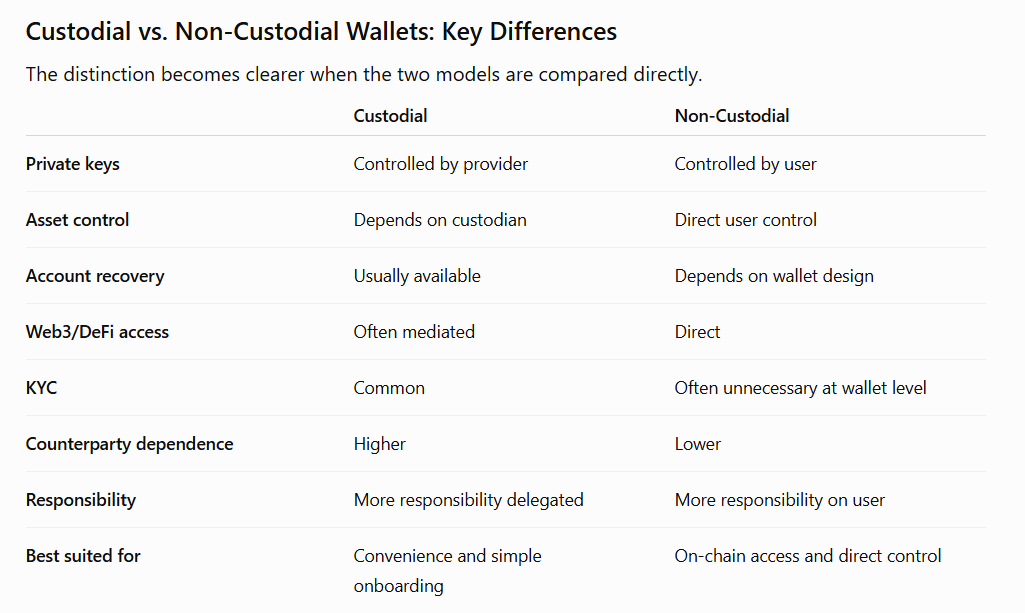
Custodial wallets can make sense for users who prioritize straightforward onboarding, account recovery, and managed infrastructure.
Non-custodial wallets become particularly useful when users want to interact directly with the wider on-chain ecosystem while maintaining control of their assets.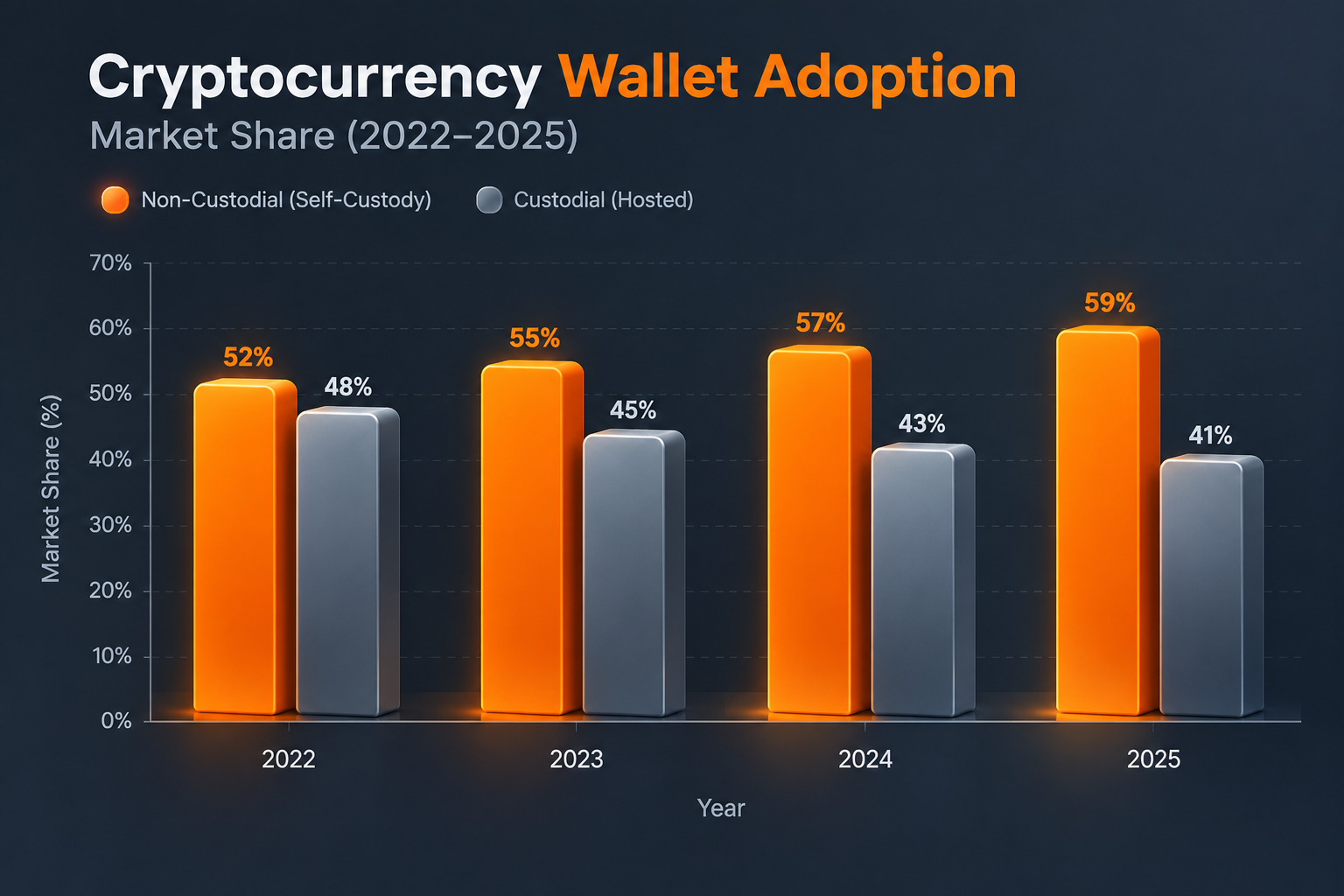
Source: CoinLaw, Self-Custody Wallet Statistics 2026. Approximately 59% of crypto wallet users globally preferred non-custodial wallets in 2025, compared with 41% using custodial solutions.
Recent data also points to strong interest in self-custody. CoinLaw reports that approximately 59% of crypto wallet users preferred non-custodial wallets in 2025, compared with 41% using custodial solutions. While wallet adoption figures vary depending on methodology and how usage is measured, the data highlights the significant role self-custody now plays in the crypto ecosystem
Why Is Self-Custody Growing?
The growth of self-custody is closely connected to a broader change in how people use crypto.
Early crypto activity was heavily focused on buying, selling, and holding assets through centralized platforms. Today, users can interact directly with decentralized exchanges, liquidity pools, lending protocols, blockchain applications, payment infrastructure, and cross-chain protocols.
As the number of activities taking place directly on-chain increases, wallets become more important.
A non-custodial wallet doesn't simply store an asset. It can act as an identity and access layer for Web3, allowing users to move between applications without first depositing their assets with each platform.
This changes the relationship between the user, the wallet, and the application.
Instead of transferring control of assets to a platform before using a service, users can connect their wallet and authorize individual transactions.
Direct Asset Control Is Becoming More Important
Self-custody also reduces reliance on a single intermediary.
With a custodial service, access to assets depends partly on the company operating the service. With a non-custodial wallet, assets remain associated with an address controlled by the user's keys.
That distinction matters in an ecosystem designed around open blockchain networks.
However, direct control shouldn't be confused with automatic security. Users can still sign malicious transactions, lose recovery credentials, interact with fraudulent applications, or send assets to the wrong address.
The security model simply changes.
Custodial wallets place more responsibility on the provider. Non-custodial wallets place more responsibility on the user.
Web3 Is Becoming Multichain
Another major reason self-custody is becoming more useful is the growth of cross-chain infrastructure.
Early blockchain ecosystems were largely isolated. Assets held on one network often remained within that ecosystem unless users navigated separate bridges, exchanges, wallets, and applications.
That experience is gradually changing.
Cross-chain protocols are connecting previously separate blockchain environments, allowing assets and liquidity to move between networks more efficiently. As interoperability improves, the wallet can increasingly become the starting point rather than the network.
The question changes from:
“Which platform holds my assets?”
to:
“Where do I want to use my assets?”
This is an important evolution for Web3. Users may increasingly interact with several blockchain networks without treating each one as an entirely separate ecosystem.
For non-custodial infrastructure, this creates an especially powerful model: users can maintain control of their wallet while accessing applications and liquidity across a growing number of connected networks.
Cross-Chain Infrastructure Strengthens the Self-Custody Model
Cross-chain technology and non-custodial wallets complement each other. A wallet provides control and authorization, while interoperability infrastructure expands where those assets can potentially be used.
This is also the model behind the LumosCore Bridge. Users connect their own wallets and access cross-chain functionality while maintaining control of their assets. Through integrations with cross-chain infrastructure providers, LumosCore brings multiple routes into a single interface, making it easier to move between supported blockchain networks.
As cross-chain infrastructure improves, users should need to think less about the underlying complexity of moving between networks and more about what they actually want to do with their assets.
Self-Custody Comes With Responsibility
The benefits of non-custodial wallets shouldn't overshadow their responsibilities.
Users need to understand basic wallet security. Recovery information should be protected carefully and should never be shared with anyone. Transaction details and permissions should be checked before approval, and wallet connections should only be made to trusted applications.
Phishing remains particularly important because a blockchain transaction generally cannot simply be reversed after it has been confirmed.
The good news is that wallet technology is improving.
Modern wallet designs are exploring better recovery systems, clearer transaction information, smart accounts, multisignature security, and other approaches that can make self-custody easier without completely returning control to a centralized intermediary.
This may gradually narrow one of the biggest historical differences between custodial and non-custodial experiences: usability.
Will Non-Custodial Wallets Replace Custodial Wallets?
Probably not entirely.
The two models solve different problems.
Custodial services can remain useful for fiat on-ramps, simplified onboarding, account recovery, and users who prefer managed services. Non-custodial wallets are better aligned with direct participation in decentralized applications and user-controlled on-chain activity.
Many users may ultimately use both.
What is changing is the role of the wallet itself. As decentralized trading, DeFi, cross-chain infrastructure, and other blockchain applications become more accessible, a non-custodial wallet can increasingly serve as a user's gateway to the broader Web3 ecosystem.
The Future of Web3 Starts With the Wallet
The evolution from single-chain applications toward an interconnected, multichain ecosystem makes wallet ownership increasingly important.
For Web3 to become easier to use, users shouldn't need to understand every bridge, routing mechanism, or blockchain underneath an application. Infrastructure can handle more of that complexity while the wallet remains the user's point of control.
That is the direction LumosCore is building toward.
Users connect their own wallets to trade, provide liquidity, launch assets, and make cross-chain swaps while maintaining control of their assets.
As Web3 becomes increasingly on-chain and multichain, self-custody is likely to remain an important part of how users interact with decentralized infrastructure.
Your keys. Your assets. Your control.